Women!
8 March 2021
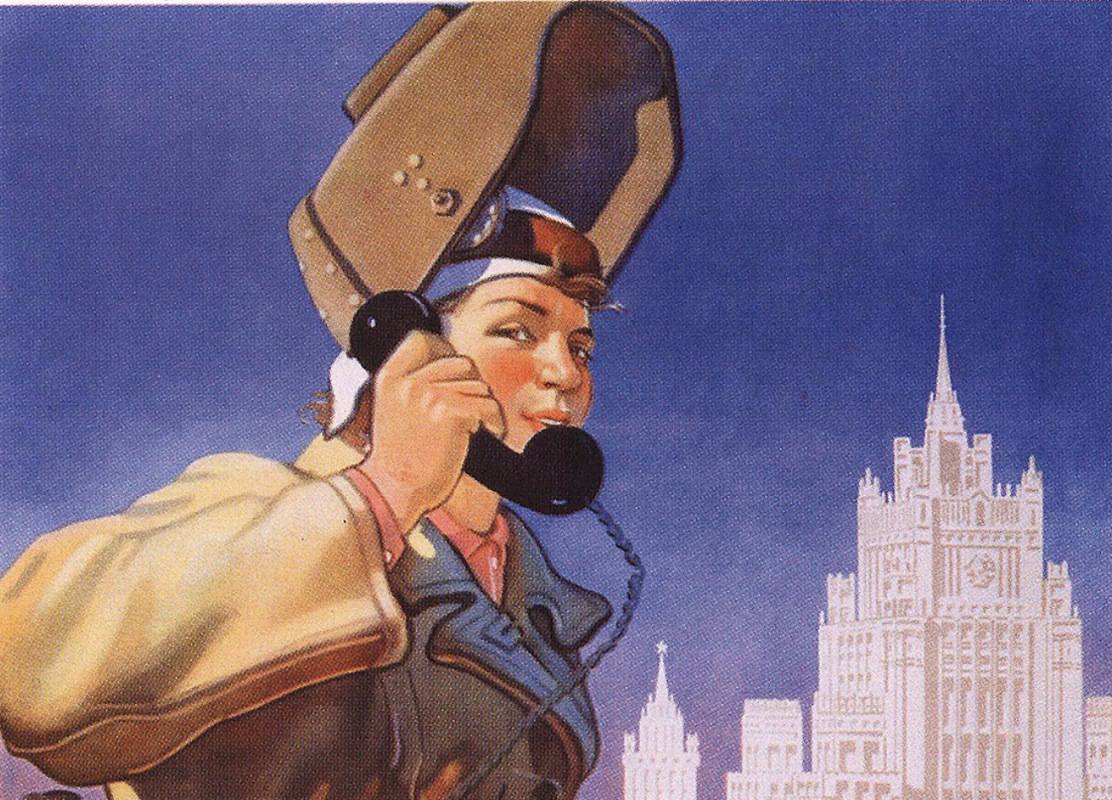
To mark International Women’s Day – 8 March – here are some extracts from Russia Beyond‘s post: ’20 Soviet Posters Exploiting Images of Women’.
The Soviet Union was arguably the first country to put the ideas of feminism into practice. Women had equal rights with men, including the right to vote (even before Great Britain and Germany). Also, women were addressed using the gender-neutral term tovarish (“comrade”), the same as men.
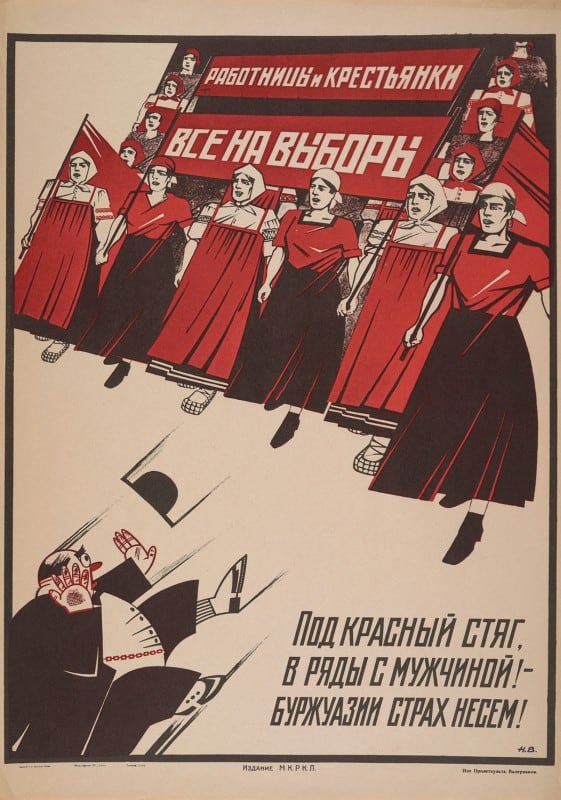
“Women workers and peasant women. All to the polls. Gather under the red banner alongside the men – we bring fear to the bourgeoisie!” (Nikolai Valerianov, 1925)
With my dress historian’s hat on, I’d like to point out the dress indicators used here – peasant women are wearing bast shoes (lapti), blouses with embroidered sleeves, sarafans and aprons, while their urban-dwelling worker sisters wear leather boots, skirts and more severe blouses. They all wear headscarves, but tied in the appropriate rural or factory-worker way. Of course in real life not every woman dressed so stereotypically but it’s useful graphic shorthand for the purpose of the poster.
Women were encouraged to be active members of Soviet society – and its benefits, as well as the shortcomings of life in the past, were explained to them. Posters like the one below graphically demonstrated that, under the old regime, women were expected to show deference to priests and bring them offerings, to put up with beatings from their husbands and dedicate themselves to looking after the children and doing the household chores. By contrast, the new life proclaimed the “implementation of the precepts of Ilych [Lenin]”, urging women to “sew, cut out patterns and stitch” together in amicable harmony and to learn to read and write. A wife could now take the children to the nursery and become a fully fledged member of society.
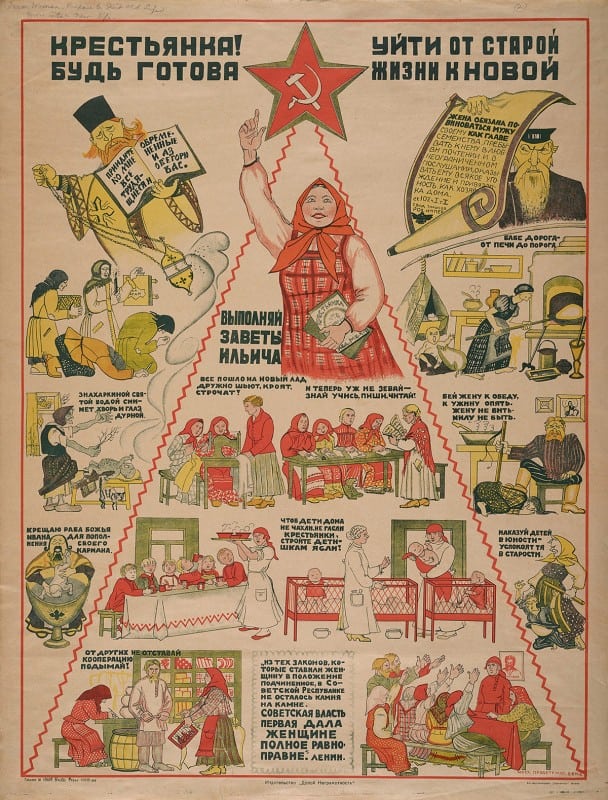
“Peasant Woman! Be ready to swap the old life for the new” (1919-1921, Publisher: Doloi Negramotnost – ‘Down with Illiteracy’)
Numerous posters were dedicated to International Women’s Day on March 8. The women of Petrograd (now St. Petersburg) had staged a mass demonstration on this day in 1917. The day was regarded as a celebration of women’s emancipation. On posters dedicated to the event, women were portrayed as revolutionaries, workers, peasants and mothers and later they were just beautiful women with flowers. (Note from me – not ‘just’ in the two flowery posters below. See the hard hats and serious construction and engineering projects going on behind them).

“March 8 – A day of rebellion by working women against kitchen slavery. Down with the oppression and vacuity of household work” (Boris Deikin, 1932)
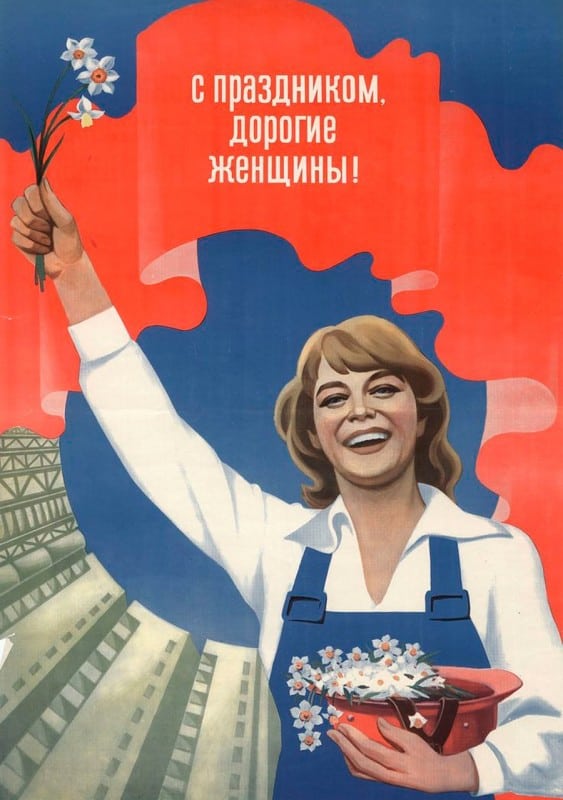
“Happy Holiday, dear Women!” (V. Konyukhov, 1979)
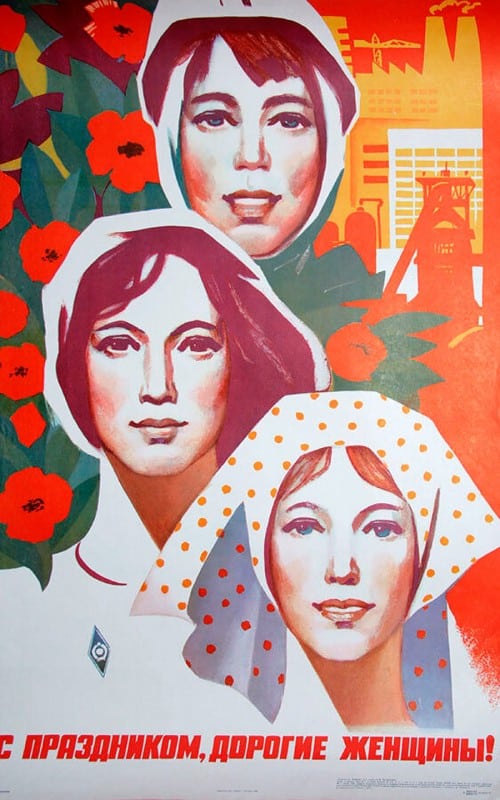
“Happy Holiday, dear Women!” (I. Kominarets, 1976)
Collectivization and industrialization were in full swing in the country and women were needed as labour. They were encouraged to work and master a whole variety of professions, including those traditionally undertaken by men, such as tractor operator or train driver.
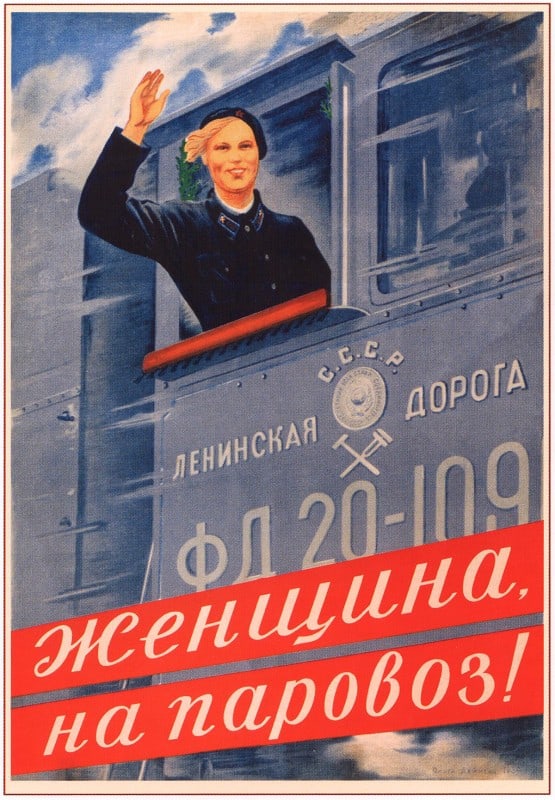
“Woman. Get onto a steam locomotive!” (Aleksandr Deineka, 1939)
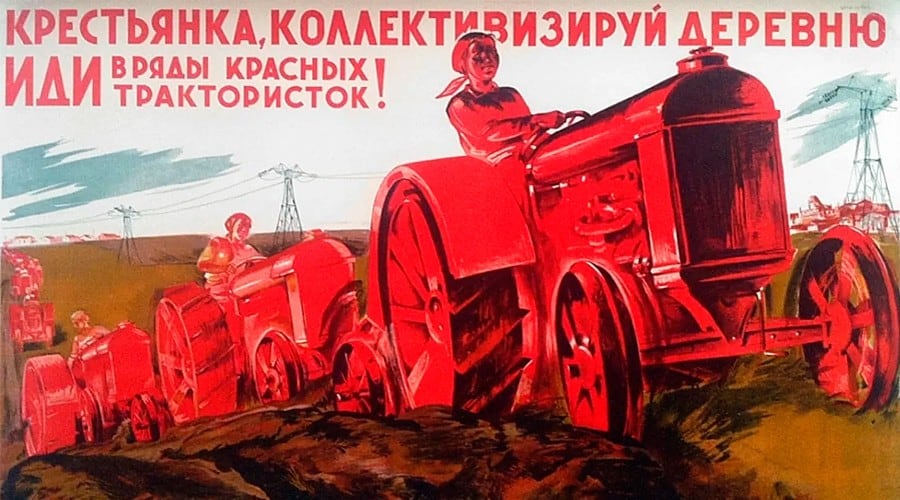
“Peasant woman, help to collectivize the village. Join the ranks of red women tractor drivers” (State publishing house, 1930s)
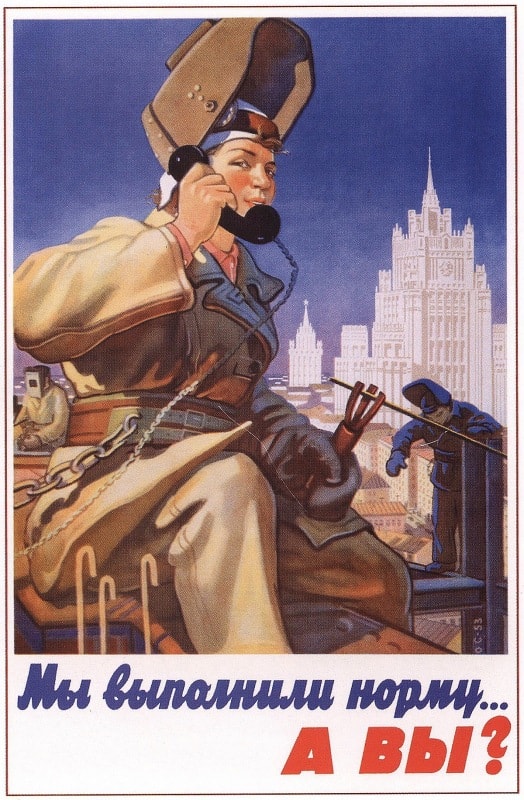
“We have met the quota… And you?” (Oleg Savostyuk, 1954)
The Soviet authorities controlled all spheres of life – and even the way women raised their children. Posters gave women precise instructions on how to feed and care for their infant and also how to look after their own health, calling on them to actively engage in physical exercise.
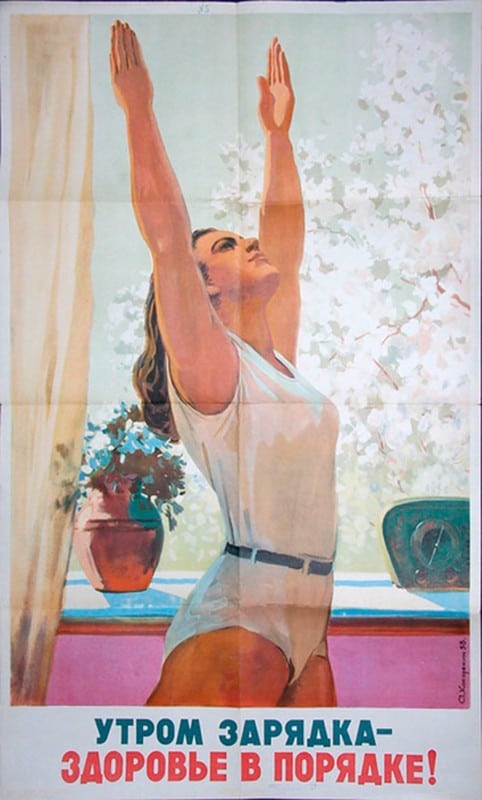
“Do your morning exercise – enjoy sound health” (Alexei Kokorekin, 1957)
(The full Russia Beyond post is here.)