‘Like jam from a spoon…’
26 August 2021
I remembered a Russian language poem that mentions raspberry jam (and embroidered towels, which also interest me….)
By Eduard Bagritsky, written in 1919:
I am pleasantly exhausted by silence and dreams,
By creeping boredom and inexpert singing,
I like the cockerels on the white towels
And the ancient soot on the austere icons,
To the hot rustling of flies days succeed each other,
Each filled with most devout humility.
A quail mutters beneath the low ceiling,
And on feast days there is a smell of raspberry jam.
And at night the tender goose-down is oppressive,
The stuffy icon-lamp flickers harassingly,
And a cockerel embroidered on the towel
Stretching out its neck, starts to crow in a long-drawn-out manner.
There, O Lord, you have given me a modest retreat
Beneath a kindly roof that knows no agitation,
Where hard days fall endlessly in thick drops,
Like jam from a spoon.
-o-o-o-o-o-o-o-
Я сладко изнемог от тишины и снов,
От скуки медленной и песен неумелых,
Мне любы петухи на полотенцах белых
И копоть древняя суровых образов.
Под жаркий шорох мух проходит день за днем,
Благочестивейшим исполненный смиреньем,
Бормочет перепел под низким потолком,
Да пахнет в праздники малиновым вареньем.
А по ночам томит гусиный нежный пух,
Лампада душная мучительно мигает,
И, шею вытянув, протяжно запевает
На полотенце вышитый петух.
Так мне, о господи, ты скромный дал приют,
Под кровом благостным, не знающим волненья,
Где дни тяжелые, как с ложечки варенье,
Густыми каплями текут, текут, текут.
There is always a dilemma, reading foreign literature in translation. Especially poetry. Part of the writer’s intention and certainly the music of the language must be compromised, or at least altered. This poem is in my 1962 edition of the Penguin Book of Russian Verse, in Russian with the English beneath. The translation doesn’t attempt to replicate the rhythm or rhyme scheme of the original but tells us what the words mean, albeit in a way that actually reads well as free verse, I think. The original structure surely serves the poet’s aim to conjure up monotony and languor and a feeling of time barely passing. The effect of the last line is certainly lost in translation. The repetition – текут, текут, текут (pronounced tekut, tekut, tekut. From the verb Течь, meaning ‘to flow’) – evokes the movement and the sound of the jam falling slowly from the spoon, drop by drop.
I found another version in English which does impose a rhythm and rhyme scheme to mirror the original but I’m not keen on it. Apart from ‘roostered fringe’ and ‘jamlike viscous motion’. Those are quite pleasing.
A note about towels – and cockerels…
I wrote a previous post exploring the form, function and meaning of embroidered towels in eastern European culture. They’re called полотенце (pron. polotentse) in Russia, and рушники (rushnyky) in Ukraine.
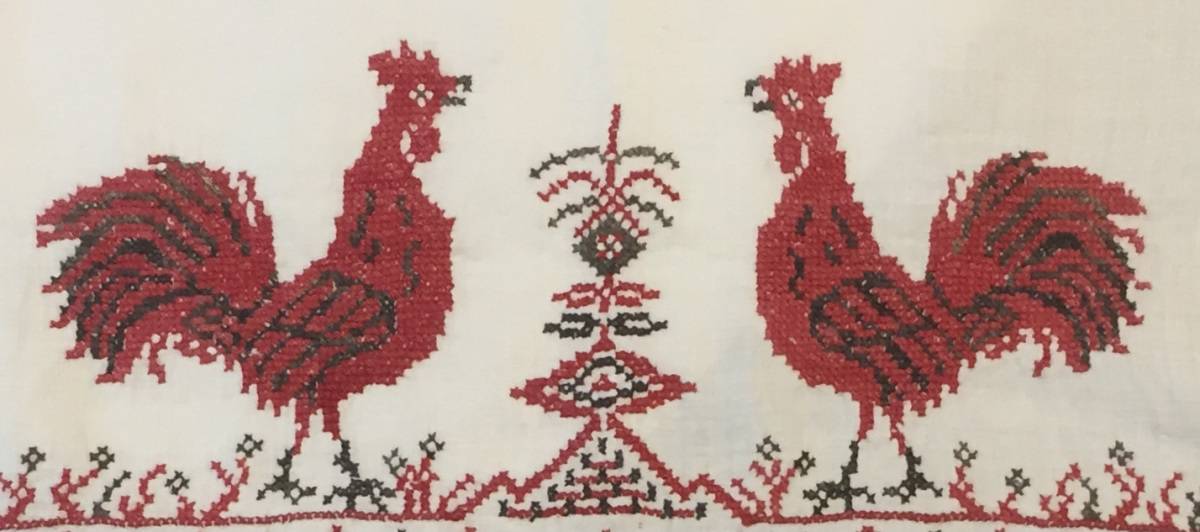
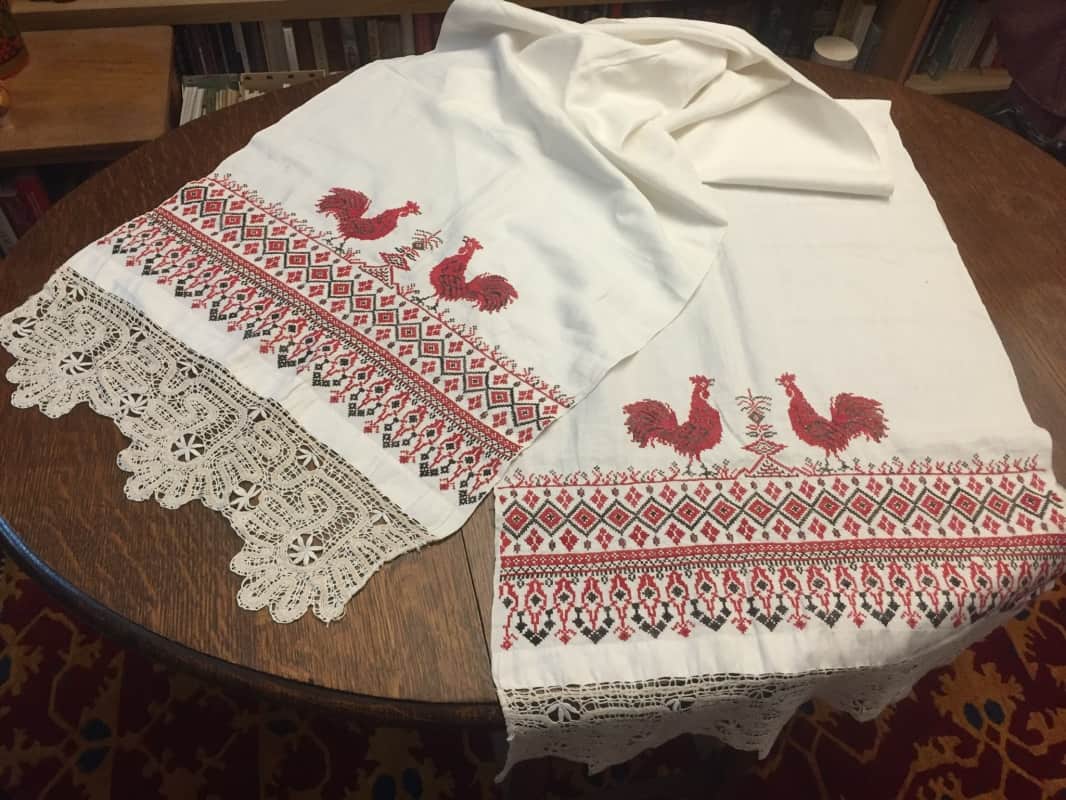
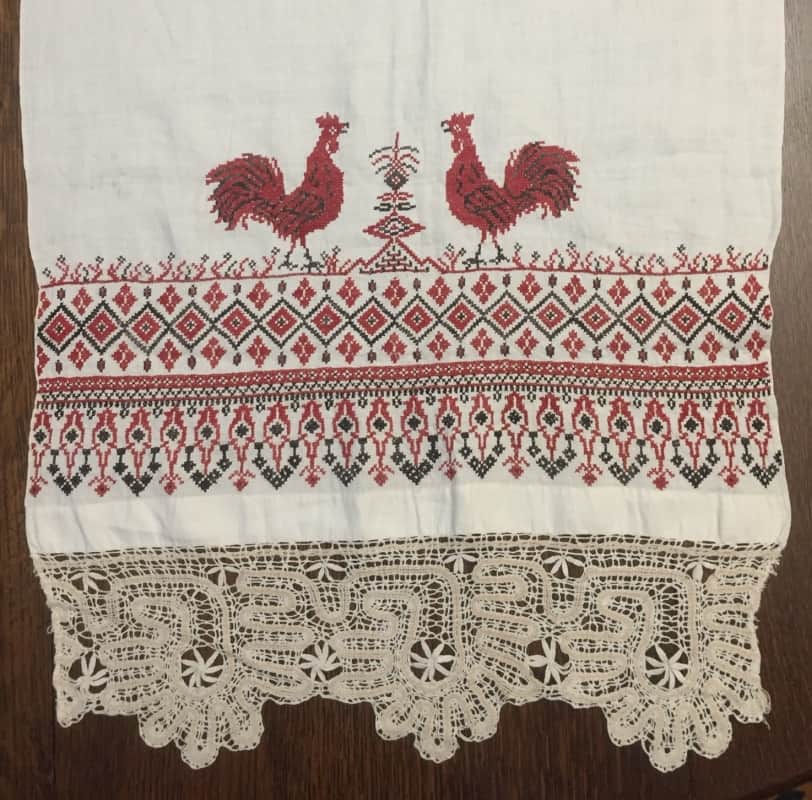
Cockerels (петух, petukh): In Russian fairy tales the cockerel is associated with the sun, as well as with good fortune and fertility. They can be found on many household items. When there are two of them with their heads together, it indicates that this was probably a wedding gift, to wish the bride and groom a happy marriage.
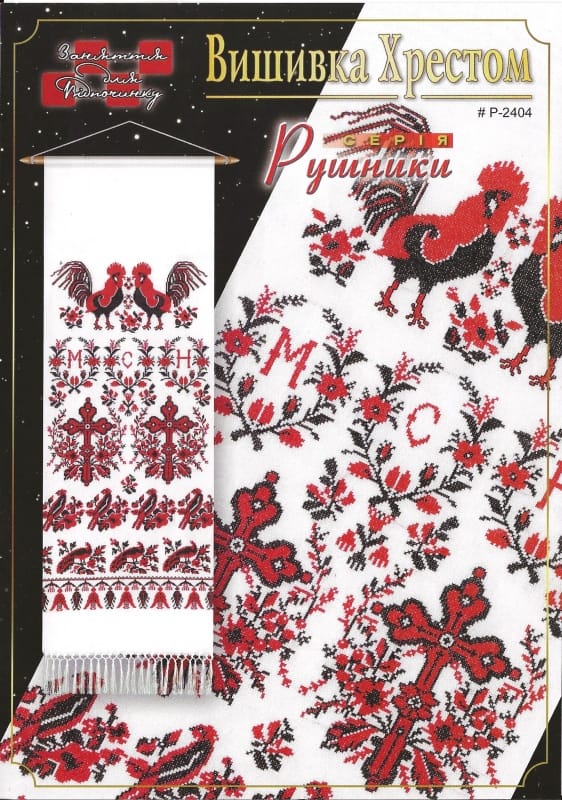
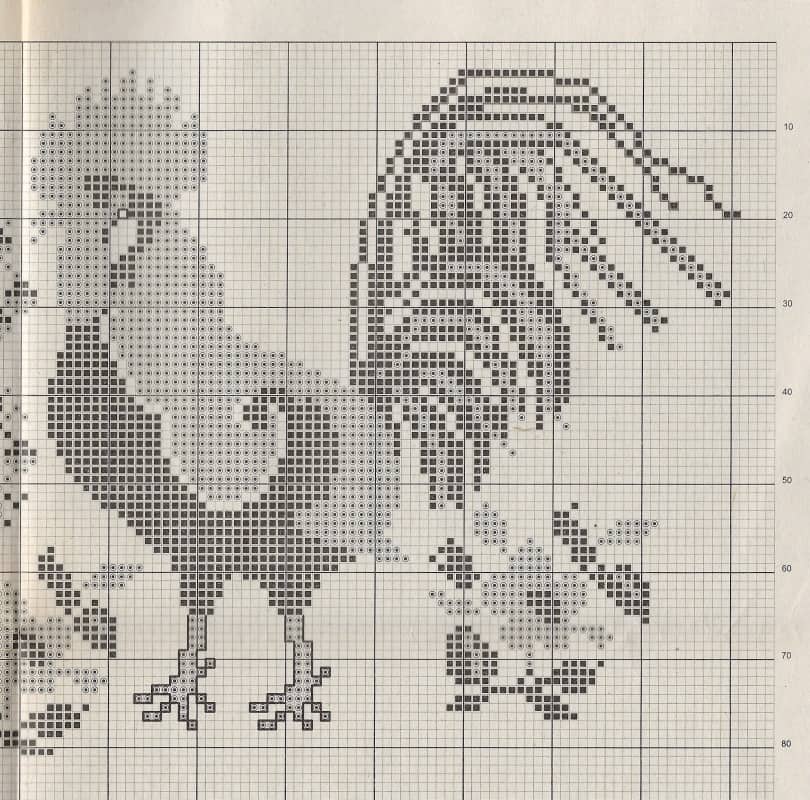
When I was in Ukraine some years ago, I bought a couple of patterns for making rushnyky embroidered in typical cross-stitch designs. One of them features cockerels.
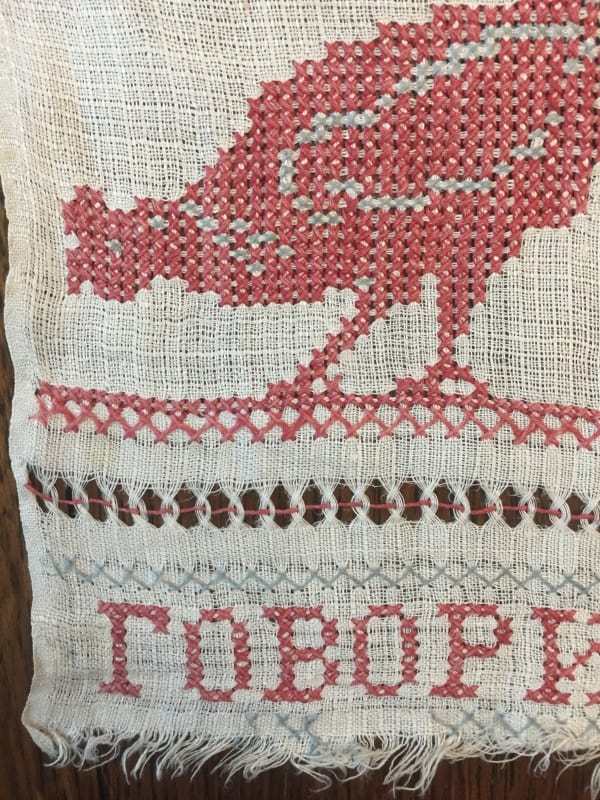
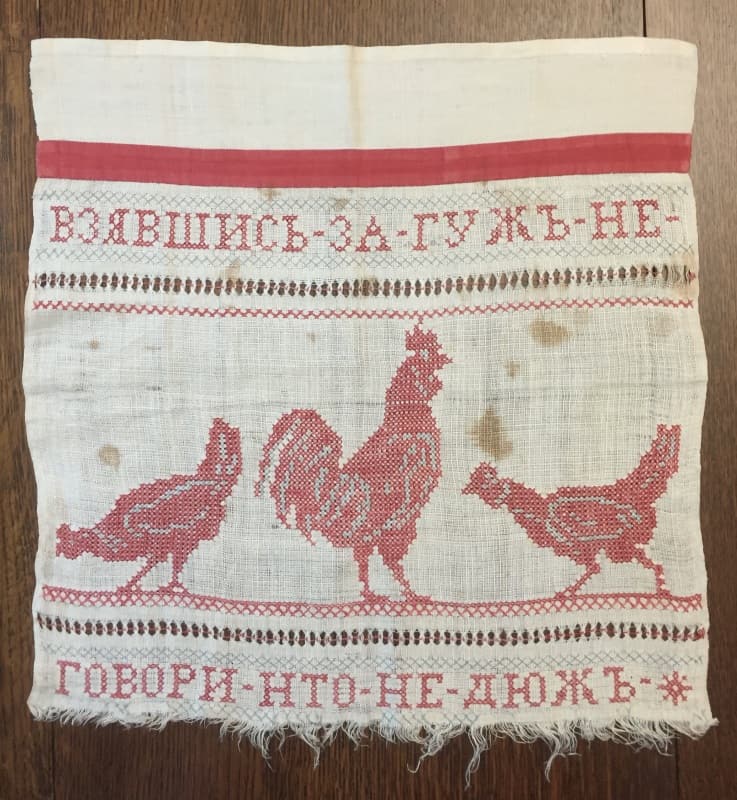
Two of the pieces in my textile collection have cockerels on them. One is a very old, stained and frail fragment including a Russian proverb that I can’t figure out at all. If any Russian speakers read this and can explain it to me, I’d be grateful!
The other is an extremely long, fine towel with the design embroidered in cross stitch at each end, and trimmed with hand-made lace.
Incidentally the first story in Mikhail Bulgakov’s ‘A Young Doctor’s Notebook’ is called ‘The Towel with a Cockerel Motif’ (Полотенце с петушком). It’s an extremely gory account of an amputation but the patient lives and gives the doctor an embroidered towel in gratitude. It’s a relatively calm ending which comes as a relief after the horror of the preceding narrative.
‘Then, hanging on her crutches, she undid a package, and out of it fell a long, snow-white towel with an artless red cockerel embroidered on it. So that was what she had been hiding under her pillow during examinations. That’s right, I remember, there were cottons on the bedside table.
‘I won’t take it,’ I said sternly, and even began shaking my head. But she made such a face, such eyes, that I did take it…
And for many years it hung in my bedroom in Muryino, and then it went with me on my wanderings. Finally it grew ragged, faded, became full of holes, and finally disappeared, fading and disappearing just like memories.’