17 November 2021

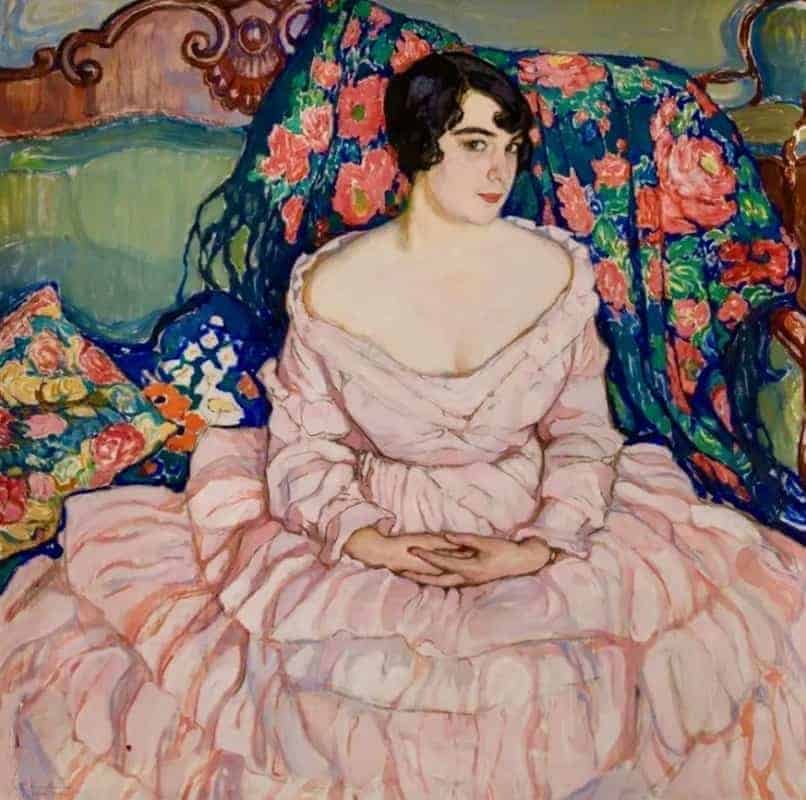
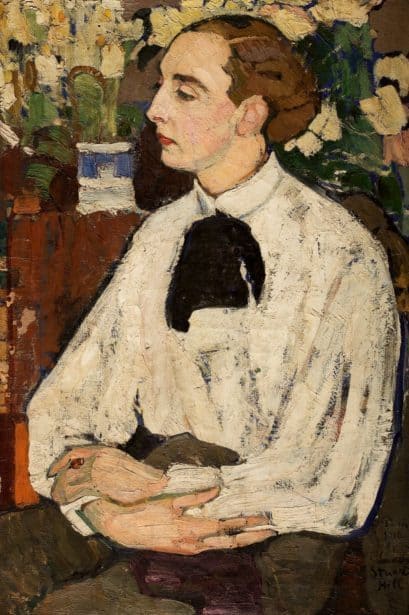
Marusya. 1913 (Voronezh Museum)
I’ve learned a lot from the ‘Эрмитаж’ public group page on Facebook. Contributors write about artists of many nationalities and styles, but the posts that catch my attention, are (of course) those about Russian artists and particularly ones that are new to me. I’ve discovered lots of fascinating images and stories from this source. Recently there was a post about Elena Kiseleva (pronounced Kisalyova), who lived from 1878 to 1974. Finding out about her life and works, and setting them into the context of the turbulent 20th century – especially as experienced in Russia and the Soviet Union – reinforces to me the value of the study of art history. It is never just about the pictures.
Kiseleva’s ability was recognised and celebrated in Russia in the early years of the 20th century but after she left to settle in Belgrade in 1921, she became isolated from the Russian artistic community. She continued to paint but her works were rarely exhibited after the 1920s. At the beginning of her career she had studied in the St Petersburg studio of Ilya Repin, who, saddened after her departure by the absence of works by her in exhibitions in Russia, wrote to her: ‘It cannot be true that you have given up painting. I could never believe that. You are too talented to do that. I do hope that you will make us happy by painting new works.’
The story of how she was ‘rediscovered’ in the 1960s is intriguing. In 1967 a senior researcher from the Voronezh Art Museum, Margarita Luneva, found in the archive of the Academy of Arts in Leningrad a letter from Kiseleva to Repin, sent from Belgrade in 1921. Luneva wrote to the address given in the letter and discovered that the 88-year-old artist was alive and still living at that address. A correspondence began and, not long after, Kiseleva gave a large number of her works to the
Voronezh Museum. In 1969 an exhibition of fifty of her works was held there, to mark her 90th birthday.
In 2017 the first retrospective exhibition of Elena Kiseleva’s work – ‘
The Elegant Epoch‘ – took place at the Museum of Russian Impressionism in Moscow, and was subsequently shown in Voronezh under the title ‘Shine, oblivion and return to the light’.
Elena Andreevna Kiseleva was born in Voronezh in 1878 into the family of Andrei Petrovich Kiselev, a teacher of mathematics (whose name, I read, was well known to generations of Russian and Soviet school children, who studied his text books). At first Elena also considered entering this field, enrolling in the mathematical department of the Bestuzhev Courses in St. Petersburg. But in 1898 she entered the Higher Art School at the Academy of Arts, and from 1900 to 1907 studied painting in Repin’s studio. She was the first pupil in the history of the Academy awarded the right to a working trip abroad. From 1908 she continued her studies in Paris.
Kiseleva wrote: ‘The composition (still life?) or landscape was of little interest to me. I’ve always been a portraitist and passionately loved portraying beautiful, interesting women.’
The portrait of Marusya was donated to the Voronezh Museum in 1929 by the artist’s mother. Its reception when first exhibited there was inauspicious. Art critics of the time considered it as being of the genre of works praising bourgeois life and ‘decaying capitalism’. The fate of the painting was thus practically sealed. But museum workers hid it, facing the wall, on the top landing of a back staircase, where it stood safely until the evacuation of art treasures before World War II. After the war, Marusya was again put on display, and today this painting has become a symbol of the Museum.

Portrait of A P Kiselev (the artist’s father). 1906

Brides. Trinity Day. 1906-07. (Russian Academy of Arts).
There is some confusion about the name of this picture. On the cover of a 1914 magazine it’s called ‘Peasant Girls’, while in a publication from the St Petersburg Academy of Arts in 2009, it’s designated as ‘Brides. Trinity Day’. While a student, Kiseleva painted a work called ‘Trinity Day’ for a competition. Its whereabouts are unknown today. It’s thought that ‘Brides’ could have been a preparatory work for the competition piece. But its quality turned out to be so outstanding that it became acknowledged in its own right and acquired for the collection of the first Imperial Academy of Arts, (now the Russian Academy of Arts).

Young Girl in Red. 1907. May have been another preparatory study for ‘Trinity Day’

At home. Self portrait. 1908 (Voronezh Museum)
Painted in Paris, presumably in Kiseleva’s atelier on Boulevard Rochechouart, this picture conveys the high spirits of a recent graduate of the Academy.

Self portrait. 1910

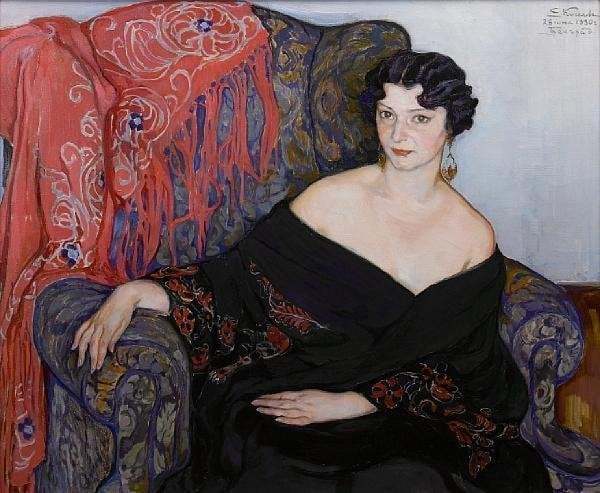
Portrait of Lyubov Brodskaya (detail). 1916 (Private collection)
This portrait depicts Lyubov Markovna Brodskaya (née Hoffman) (1888-1962) – poet, and wife of the artist Isaak Brodsky, who became a famous proponent of the Socialist Realist style. In her letter to Margarita Luneva, Kiseleva wrote: ‘I made, in my opinion, a very good portrait of the artist Brodsky’s wife. I met her in Finland at the Chukovskys’, and was amazed at her showiness and beauty.’ Lyubov’s daughter, the artist Lydia Brodskaya, wrote about her mother: ‘She was an educated, intelligent, beautiful woman. She wrote poetry, loved music, art, drew and painted, and was a member of the Union of Artists.”

Summer residents (literally ‘Dacha women’). 1915. (Voronezh Museum).
This was painted at Penates, Ilya Repin’s estate on the Gulf of Finland. The artist’s sister and daughter-in-law Maria Komissarova (Kiseleva) and Berta Kiseleva (Ritt) were the models.
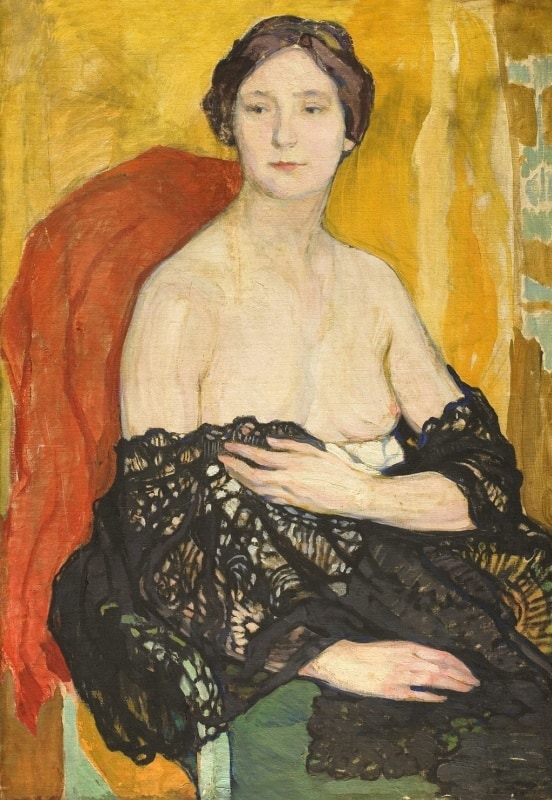
Beautiful Hortensia. 1908. (Voronezh Museum)
When this portrait was shown in 1910 at an exhibition of contemporary Russian female portraits put on by the monthly art journal Apollo, it caused a fierce debate among critics. Some accused Kiseleva of failing to find a single modern Russian female type – ‘a real Russian woman – a woman-mother who heroically builds and mends our crumbling modern hearth, who goes to war, to prisons, to hospitals, to science, art and literature.’ But another critic wrote in the same issue, objecting to the attacks and saying that ‘in this case the woman is revealing her aesthetic, and not her real self’.
On the balcony. 1910 (Voronezh Museum)
This was painted on the Kiseleva family estate of Plyasovo-Yurasovo, near Voronezh. The model is Victoria Fedyaevskaya, a close friend of the family.

Mother and daughter. 1911, Collection of Roman Babichev, Moscow.
This painting was shown at the exhibition of the Union of Russian Artists in 1911-1912. Painted in Paris, two women who had come from a poor region of Italy served as models. The fate of the picture, which Margarita Luneva managed to figure out, is interesting. It was bought directly from the exhibition for 350 rubles and soon after came into the possession of the family of the publisher Sabashnikov. The original owner gave it to the Sabashnikovs to cover a debt. The picture remained with the publisher’s heirs for many years. As time passed, they forgot the artist’s name, but thought the work had some value. In the 1950s, the inscription ‘E. Kiseleva’ was spotted on the back. The painting was taken to the Tretyakov Gallery for advice, but there were no works by Kiseleva in that national collection, and the staff were unable to give any information to the owners. In 1978, by chance, the Sabashnikovs read an article in the newspaper Soviet Russia about an exhibition being prepared in Voronezh for the 100th anniversary of the artist Elena Kiseleva. They wrote a letter to the Voronezh Museum. And the picture began a second life.

Portrait of Tatiana Platonova-Pozdnyak. 1910 (Voronezh Museum)
Born into a high-ranking family, Tatiana Platonova received an excellent education at the Smolny Institute for Noble Maidens in St Petersburg. She travelled extensively and built up a significant art collection. She was gregarious and a talented musician and dancer, so that she was described as the ‘soul of society’. Elena Kiseleva met her on the embankment of the Neva near the Academy of Arts. Attracted by the interesting appearance, intelligence and education of her new acquaintance, the artist invited her to her studio where she painted this portrait, giving it to Tatyana as a present. Tatyana kept it with her when she moved to Moscow, and told friends and family about her acquaintance with the artist, and the history of the portrait. In Soviet times Tatyana lived in a communalka – a communal apartment shared by several families. After her death, her room was occupied by new tenants. All Tatyana’s belongings were disposed of. A neighbour took the portrait and, for several years, it was propped in a dark hallway, behind an old chest. The exhibition marking Kiseleva’s anniversary had taken place in Voronezh, and the artist’s name began to appear in print. In 1988 the owner of the painting, who remembered having heard about Elena Kiseleva from Tatyana Platonova, decided to take the portrait to the Tretyakov Gallery. By this time the curators at the Tretyakov knew who Kiseleva was. So this picture also began a new life. It was thoroughly restored and acquired for the permanent collection of the Voronezh Museum.

Portrait of Arseny Antonovich Bilimovich. 1925. (Voronezh Museum). The artist’s son: 1918-1944
In 1915, Elena moved to Odessa with her husband, the mathematician Anton Bilimovich, who became rector of Novorossiysk University three years later. In January 1920, Anton, Elena and their two-year-old son Arseniy emigrated to the Kingdom of Serbs, Croats and Slovenes and settled in Belgrade. Elena Kiseleva gradually retired from artistic activities and devoted herself to her family. In the early 1930s, she took part in several group exhibitions of Russian emigré painters. But she never joined the artistic community in Serbia. ‘Everyone here knows me as the wife of Professor Bilimovich and no one knows the artist Elena Kiseleva,’ she wrote in one of her letters.
During World War II, after the occupation of Belgrade, Bilimovich defiantly retired from his academic post, refusing to cooperate with the collaborationist authorities and the German administration. After the liberation of Yugoslavia, he was reinstated at the University of Belgrade. More tragically, during the war their son and his wife were arrested and sent to a concentration camp. In 1944 Arseniy returned seriously ill and died soon after. Kiseleva gave up painting from then on. Anton Bilimovich died in 1970 at the age of 91, and, four years later, Elena, at the age of 94.