The Spinner
14 January 2022
I’ve been collecting ceramic figures from eastern Europe for many years. I have a few from Hungary but most are from Russia or Ukraine. One of the earliest prompts that led to my fascination with that part of the world, and particularly its folk dress, were these four Ukrainian pieces which came from the Russian Shop in London in the 1960s.

All but one of the figures I’ve acquired in more recent times are second-hand. I bought most of them from UK-based sellers on ebay, some from auctions or antiques fairs, and a couple from markets in Russia. A few lucky finds came from local charity shops.

This is the only piece that I bought new, at full price – and the only one I have that was made after the demise of the Soviet Union in 1991. I found it in the Russian Shop in Edinburgh and thought it was full of interest, as well as being a beautiful object. It has so much to say about Russian folk dress, textiles and customs.
The title of the figure is ‘The Spinner’ – (Пряха) – as it says on the base, along with the mark of the Lomonosov Porcelain Factory of St Petersburg, the names of the designer and the maker, and the year it was produced – 2000. I have a book published on the occasion of the 250th anniversary of the founding of the Lomonosov factory in 1744 which has appendices showing all the different marks used throughout its history and a list of its designers. From this I learn that the mark on ‘The Spinner’ is the export mark used from 1992. From 1936 to 1991 it looked exactly the same, apart from the words being ‘Made in USSR’.

The book also tells me that the piece was first produced in 1989, and that the designer – Olga Mikhailovna Matveyeva – was born in 1950 and graduated from the Mukhina College of Applied Arts in Leningrad in 1974. She began work at the Lomonosov Factory the same year.
Spinning:
The traditional way of spinning thread from raw fibres in Russian peasant life (as in many societies throughout the world) – was not with a spinning wheel but with a drop spindle, which you can see here in the figure’s right hand, with thread wound around it.

This photograph, which I spotted in the home of a Romanian weaver, may help to make the process of using a drop spindle clearer:
 As it spins, the weight of the hanging spindle pulls and twists the fibres together into a continuous thread, which winds itself round the rotating spindle. The thread will then be used for weaving cloth. The Romanian woman is spinning wool, whereas in Russia the thread produced would be likely to be linen, spun from the fibres of the flax plant.
The Distaff (прялка):
Made of wood, distaffs had an upright piece on which a bundle of flax fibres was placed, often with teeth carved across the top to hold them in place. At the base of the upright was a horizontal board that the spinner sat on, to keep the distaff stable. Sometimes they are made in two pieces, with the vertical and horizontal parts slotting together, but others were carved in a single piece. There’s an interesting example in the V&A. Many intricately carved and painted distaffs can be seen in Russian museums which have collections of folk art. Often it was an object made and decorated by a young man as a love token for his sweetheart.

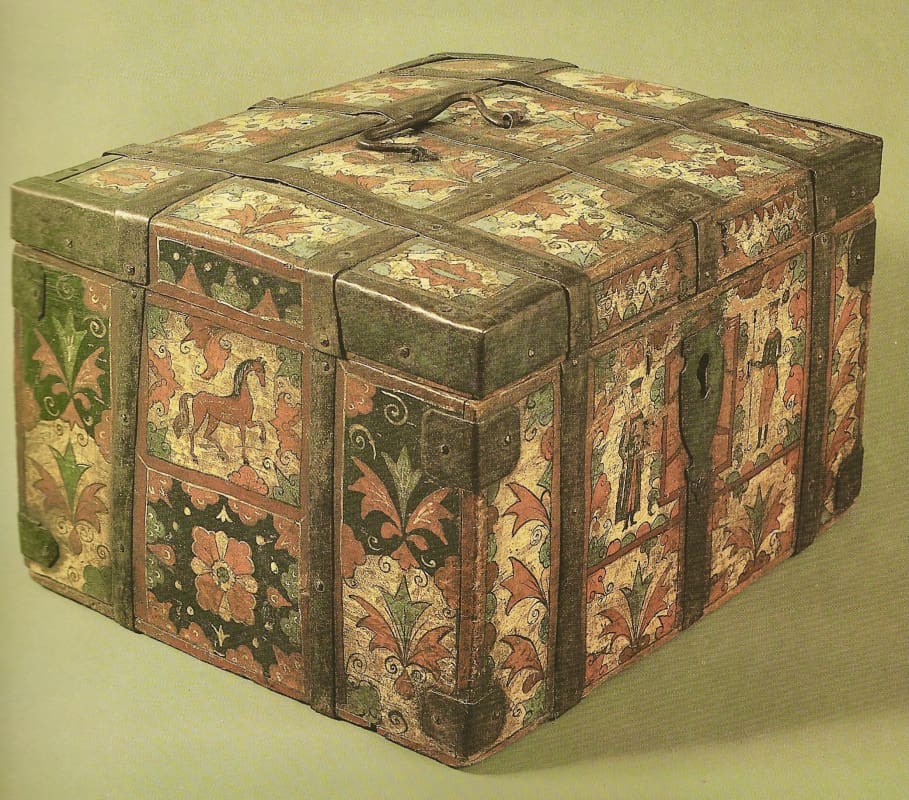
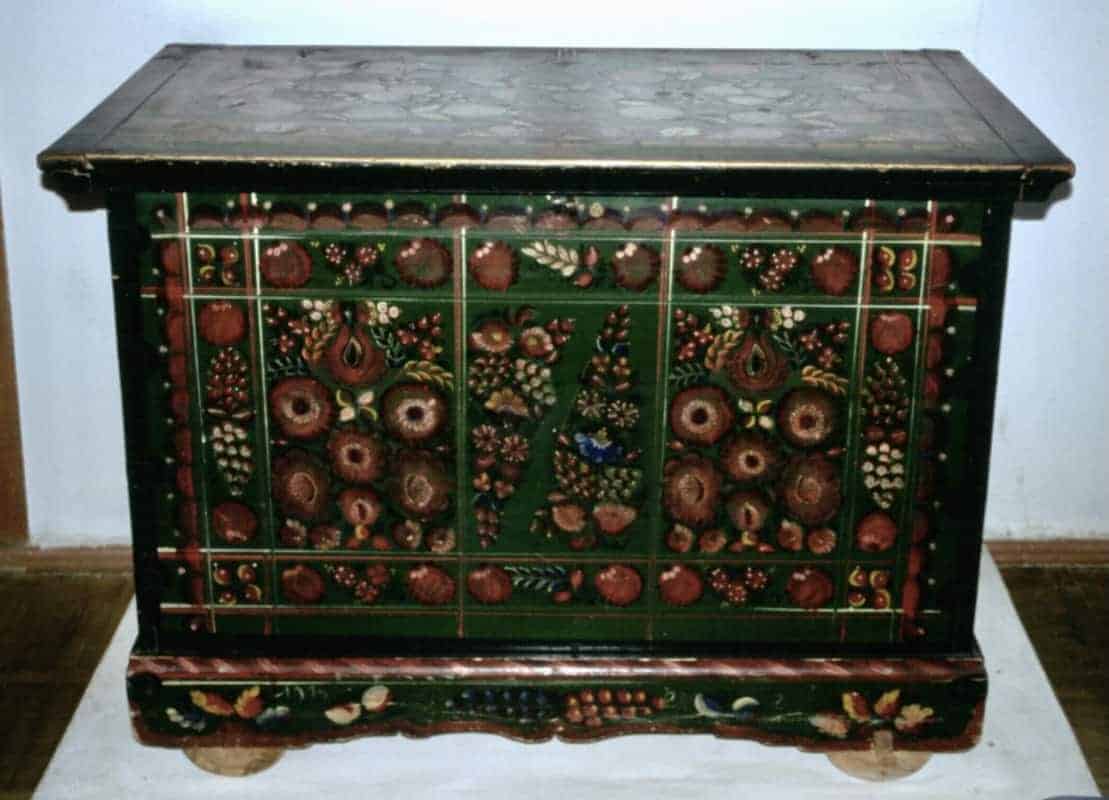
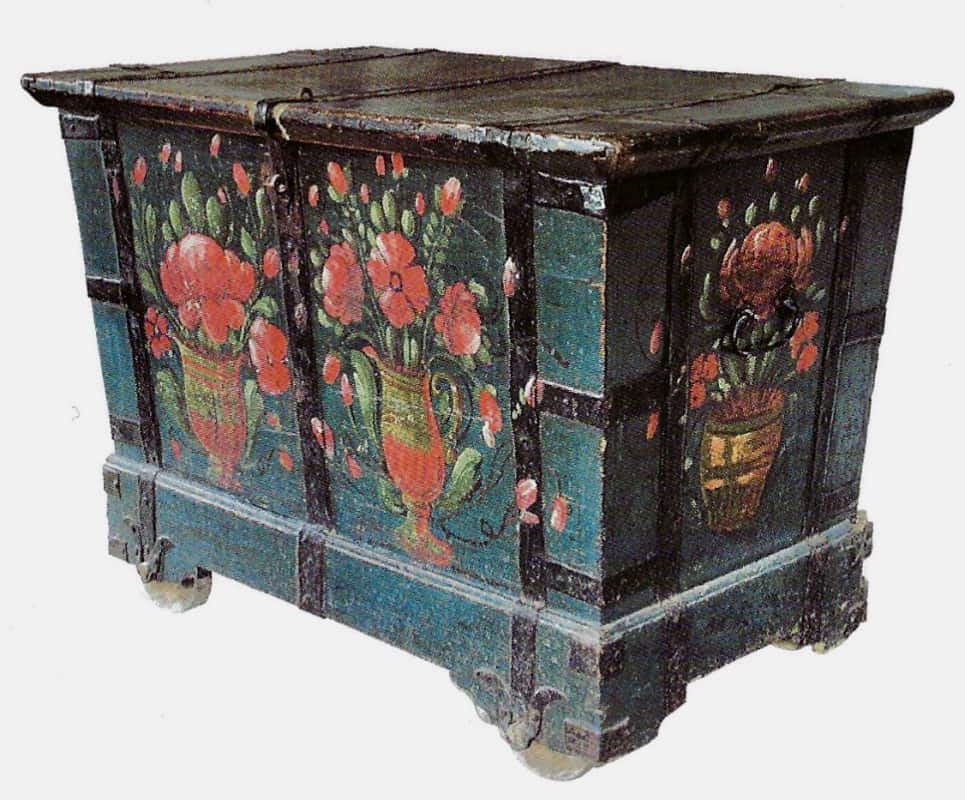
The spinner sits on her dowry chest (сундук):
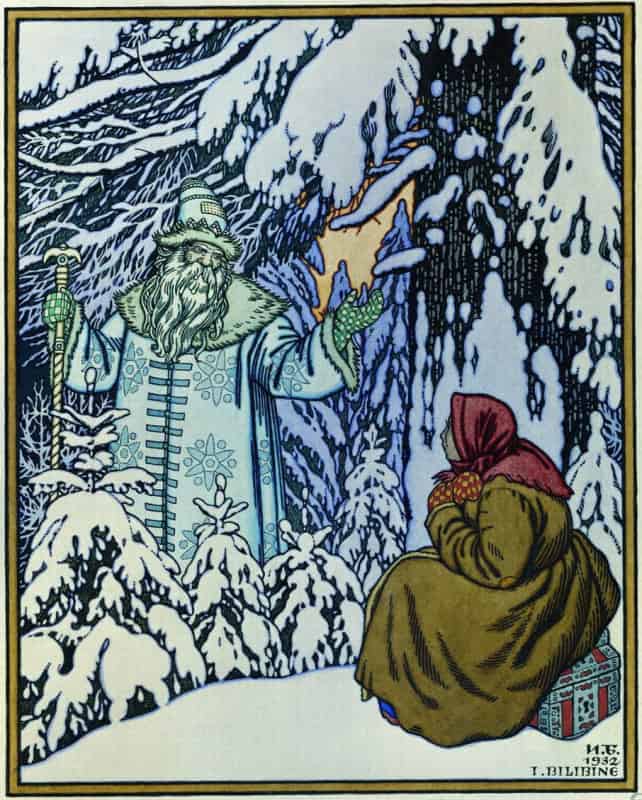
When a daughter was born to a peasant family, her father would make and decorate for her a wooden chest into which, as she grew up, she would place all the household and ritual textiles and garments she would need for her own future life. Peasant girls would learn the skills of setting up a loom, spinning, weaving, embroidering and making clothes at a young age. She would be expected to make shirts and other linen items to be given to her future husband and his family on the wedding day. When she married, she would go to live with her husband’s parents. She would take the chest with her as a reminder of her own home and the happy days of her youth. Beautifully decorated chests, like distaffs, can be found in collections of folk art, and appear in illustrations of folk tales.


 The spinner is wearing an ensemble of a sarafan (sleeveless dress with shoulder straps) made in a woven brocade fabric with, underneath, a fine linen shirt with embroidery on the sleeves, and a dushegreya (‘soul-warmer’) over the top. The dushegreya is a short jacket which could be with or without sleeves, often heavily embroidered in gold thread, with the opening at the front and distinct folds at the back. See in the photo above how the modeller has subtly indicated these folds. The photos below show front and back of such an outfit from the Nizhny Novgorod region, first half of the 19th century. (The excessively long sleeves were fashionable, a status symbol and an indication that this was to be worn on a festive occasion, when no work was going to be done.)

Make-up and hair-style:

The round red patches on the spinner’s pale face seem rather crude but this look is in fact authentic. Some years ago I wrote the chapter on Russian ethnic dress for the Berg encyclopedia of world dress and fashion. All writers had a check-list of topics to be considered and one of these was body adornment – jewellery, body modification such as tattooing, and cosmetics. I found this interesting as I hadn’t really thought about that aspect of ‘dress’ before – just the clothes. Here’s an extract from my chapter:
‘In Russian peasant life, there was a specific understanding about the concept of beauty. Different ideals of beauty applied to a woman at various stages of her life. The first crucial stage is reaching puberty, at which point a girl’s long loose hair is braided into a plait interwoven with red ribbons – a direct sign to the community that she is ready for marriage. Between puberty and marriage, a girl should be a virgin but is now considered mature enough to marry, to bear children, and has all the necessary household skills for her future life. At this moment, she should be the best, the most beautiful she will ever be in her life. This beauty of the potential bride had some kind of magical force, symbolised by the material items and clothes associated with this stage. She prepares to say goodbye to her unmarried friends and her parents’ home and, from the time of her betrothal until her marriage, acquires a new higher social status. Her life is considered for this brief time to be easy and pleasant, and she presents the personification of beauty – highly decorative, with her long plait, ribbons, and a red-and-white face.
Cosmetics were essential for girls of marriageable age and young married women. Flour, sugar beet, milk, cucumber juice, beech tree sap, lily of the valley, and stearin (derived from animal fat) were all means of whitening the face. Triangular or round red shapes were applied to the cheeks – traditionally with beetroot, but, at the beginning of the twentieth century, the colour might be obtained by rubbing sweet wrappers printed with red ink on the skin. Eyebrows were blackened with kohl or charcoal mixed with fat or by itself, and teeth were whitened by chewing sulphur. Beauty also sprang from a girl’s attitude to life – she must be positive, with a joyful spirit, plenty of energy, the ability to dance, drawing everyone’s eyes to her.
Many of the customs around marriage signified the loss of innocence and the moving back to a lower social status. Sexual relations marked the end of beauty. Part of the whole was destroyed, and hence the venets – the maiden’s circlet headdress – was symbolically broken into pieces. Her beautiful plait was undone to prepare for her hair to be hidden from public view forever under her married woman’s headdress. Before the wedding, a bride’s unmarried friends might create a ‘marriage tree’ decorated with ribbons. This was placed on the table at the girl’s prewedding party, and much crying took place, saying goodbye to the tree and to beauty. The bride would give parts of the tree or of her venets to her unmarried friends and younger sisters in the belief that by so doing, she could pass her beauty on to them, preserving it by spreading it among the group.’

Vasily Feklistov: Приготовление невесты к венцу. Preparing the Bride for the ‘Venets’ – (ie the giving up of the venets). 1848 (detail)
But the Spinner has not yet reached that unhappy state and still has her maiden’s plait intact.

I think the big blue bow at the nape of her neck is a bit of artistic licence on the part of the designer. It departs from the traditional red colour, and adornment of a girl’s plait was usually placed at the end of it, in the form of a beautifully embroidered ‘kosnik’ (the word for plait being ‘kosa’). Here are some examples:


 This image from my book on Lomonosov porcelain shows the original design for the Spinner from 1989. I think my 2000 version is prettier – and it’s interesting to note that the position of the drop spindle in the two models is different. It’s completely attached to the skirt in the later one, presumably making it less vulnerable to breakage than the original.
I like to think of Olga Matveyeva considering all these elements of folk culture as she designed the piece. None of my other ceramic figures has as much to say as this one, but I plan to write a series of shorter posts about some of them in the future.