Buying Fabrics and Threads in Soviet Moscow
14 June 2021
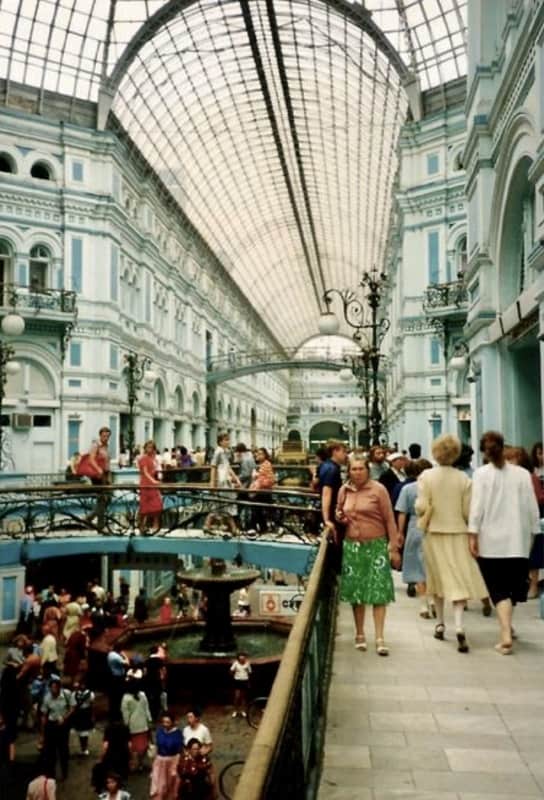
Inside GUM, 1987
Recently, when I was putting together a talk about the origins of patchwork and quilting in Russia, I was reminiscing about what it was like shopping for fabrics and threads there in the late 1980s. When I arrived in Moscow in May 1987 I was two terms in to a four-year part-time City & Guilds course in embroidery and design. My tutors from the college in Windsor sent me details of the assignments I needed to fulfil, and I was quite productive, having taken my sewing machine and plenty of other equipment with me. I kept a sketchbook and was very focused on both producing my own work and finding out about the creative textile scene in Moscow. I had the idea that it would be interesting to produce work using only Russian fabrics and threads, but it turned out to be much more difficult than I’d anticipated to find any promising materials in the shops.
The received wisdom in the West about life in the Soviet Union was that people there had to queue to buy anything – and I discovered that this was largely true. (I got very good at being patient in a queue – mentally zoning out – and it’s a skill that has stood me in good stead ever since.) Queues were longest for the more desirable consumer goods such as clothes, and particularly shoes. And there wasn’t a lot of choice – you bought whatever had happened to arrive at the shop. It was much the same in food shops. You could always get tinned fish, milk and bread but not much else was guaranteed to be available. You had to go to the baker’s every day because the bread didn’t keep, but went dry and hard by the next day. Even in the markets, where you could find fresh fruit and vegetables brought in from the countryside, you couldn’t be sure of what you’d be able to buy. I remember a glut of limes and, another time, aubergines. You had to decide what to make according to what you found. It was no use deciding in advance and going out with a shopping list. Cooking became a properly creative exercise, which I enjoyed. I could make good desserts using the chunky tinned apples that were usually available – at least, they were in the ‘Diplomatic Gastronom’. Having diplomatic status in Moscow, we were able to buy food in this special store, which was much better stocked than the food shops available to everyone. I was a little ashamed of going into this shop, knowing that most Moscovites were not able to shop there. (They could if they had hard currency to spend – such as US dollars.) The windows on to the street were blacked out so that people couldn’t see what they were missing. Even in that shop the choice was very limited. I remember that, when we were back home in the UK and I went to our usual supermarket to buy food, I was bemused and almost in a state of panic at the amount of choice. It felt confusing – even immoral. And certainly unnecessary.
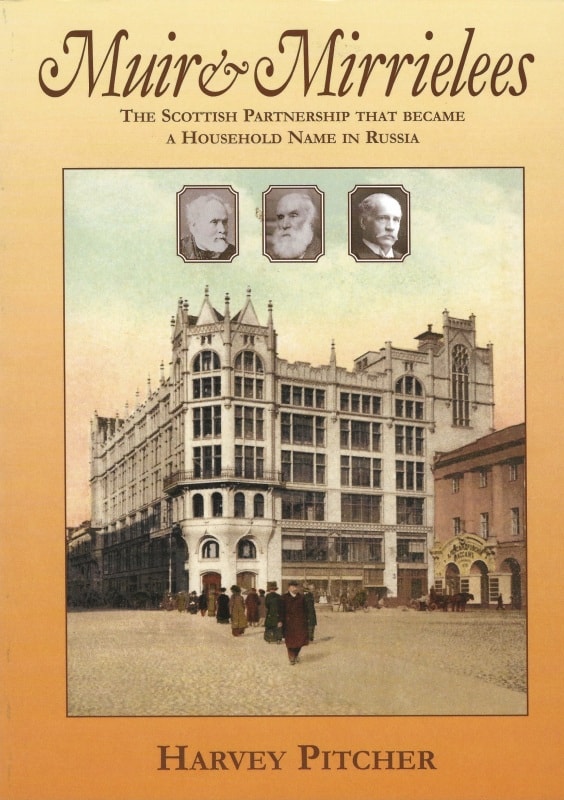
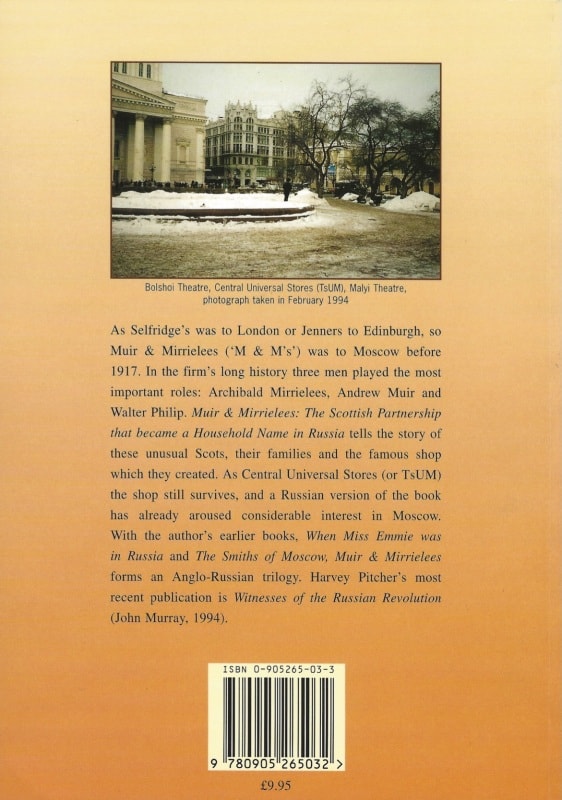
Before setting off for our Moscow posting, I thought it was an urban myth that people in the Soviet bloc would join a queue without knowing what was on sale at the end of it. But there seemed to be some truth in it. If there was a queue, there was bound to be something desirable – and hard to come by – that had just arrived and might at any moment disappear again for goodness knows how long. I experienced this phenomenon myself in TsUM – the largest department store in Moscow after GUM in Red Square – TsUM being the Central Universal Department Store – Tsentralʹnyĭ Universalʹnyĭ Magazin. (In Russian: ЦУМ – Центральный Универсальный Магазин.) This store, situated near the Bolshoi Theatre, has a fascinating history. Before the Revolution it was called Muir and Mirrielees, after its Scottish founders. There’s a book about it by Harvey Pitcher –
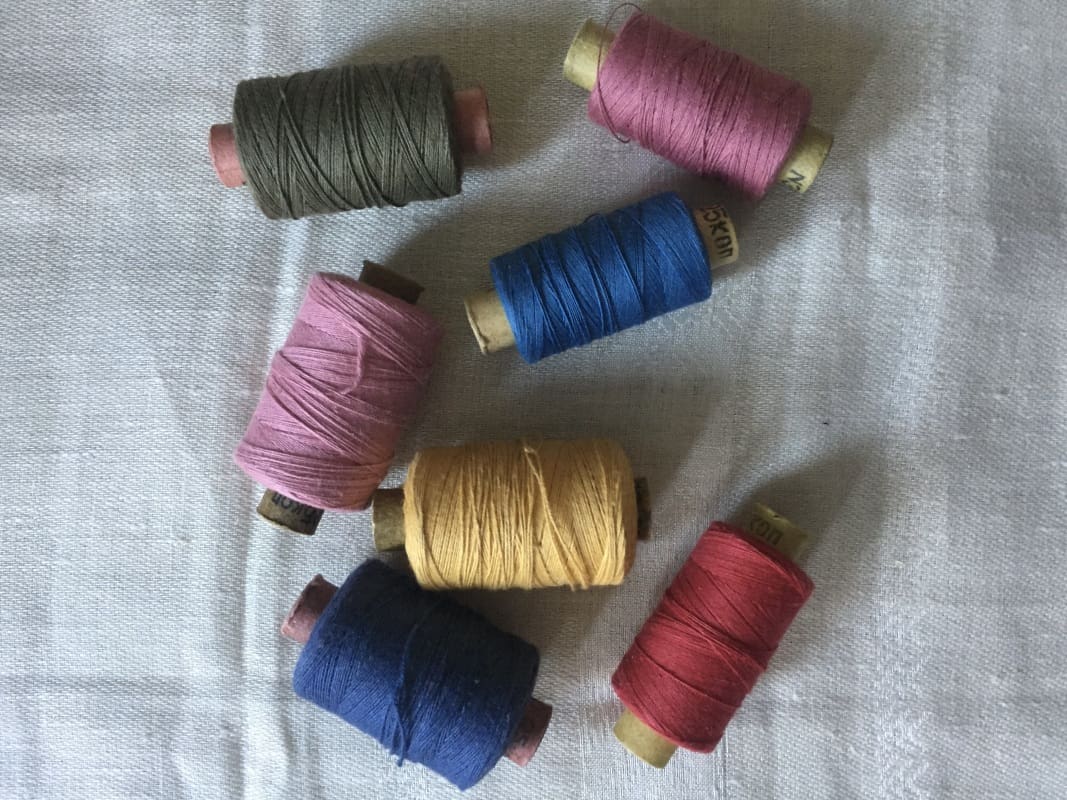
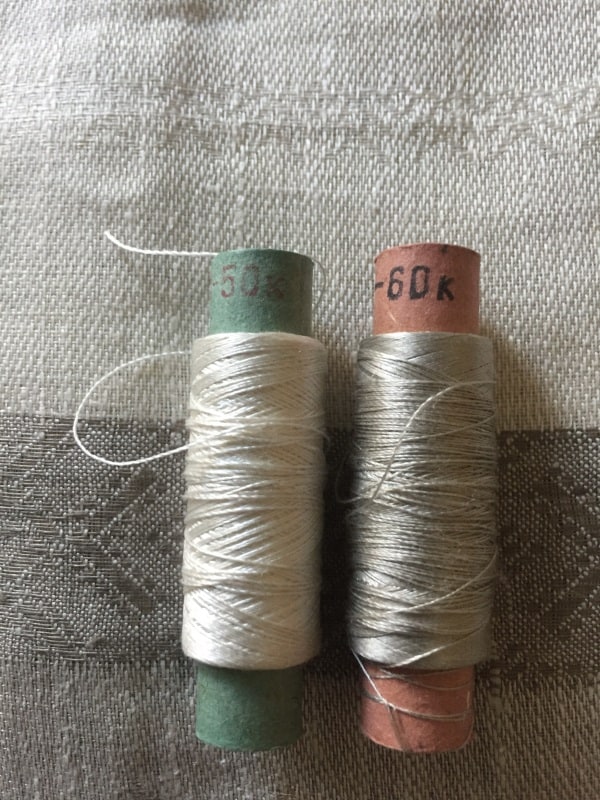
There was a long queue snaking away from the counter, and I couldn’t see what was at the end of it. I didn’t have enough spoken Russian to ask anyone, so I queued up anyway. I was quite astonished – and delighted – to find, when it was finally my turn to be served, that being sold were stranded embroidery threads. I bought one of each colour and the assistant put them in a box made of that typical Soviet-era rough cardboard of which I am inexplicably fond. I also bought some reels of cotton for hand or machine sewing. Like most things in the shops in Soviet times, all the threads had the price printed on them – 25, 50 or 60 kopeks – so there was no chance of anyone selling them at anything other than the official amount. Some of the threads – including the stranded cottons – were more matt than the ones I was used to buying in Britain.

Мулине = ‘floss’ (embroidery thread)

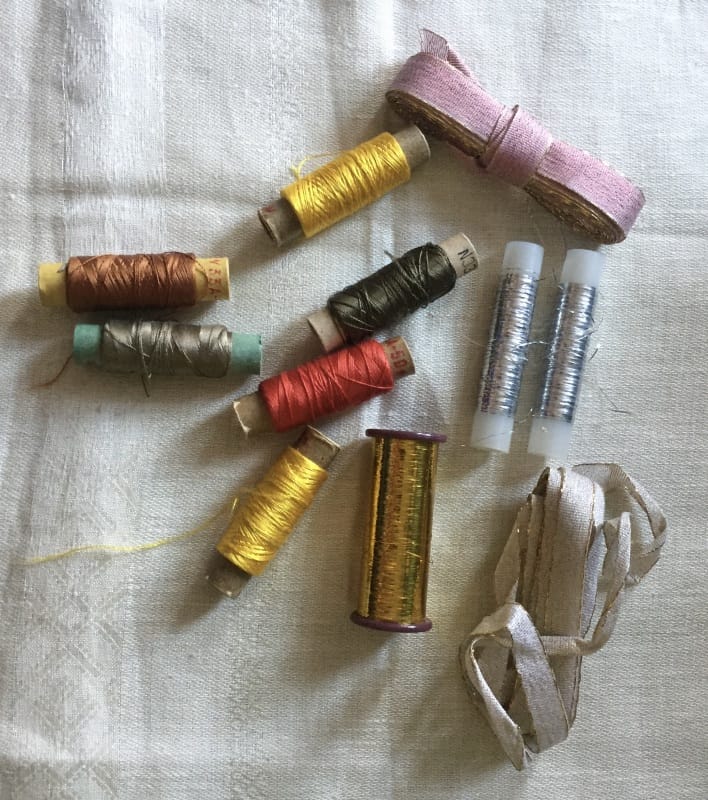
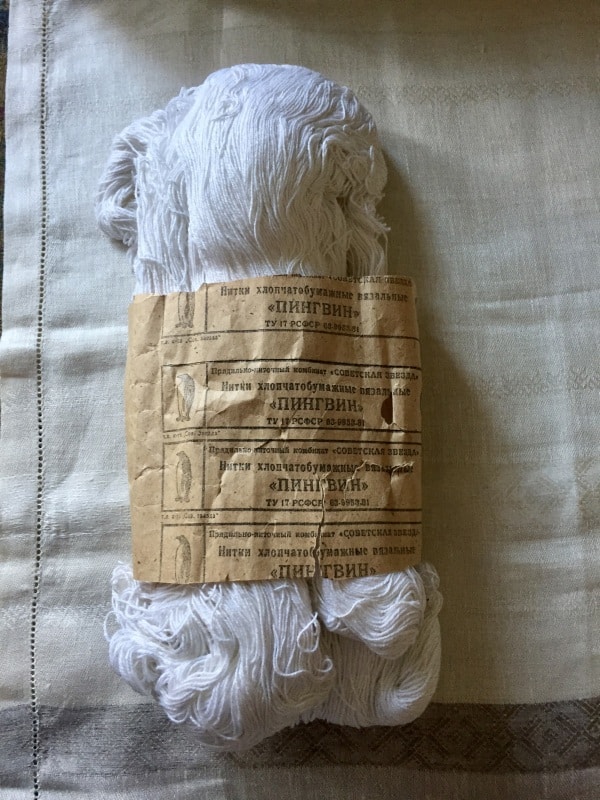
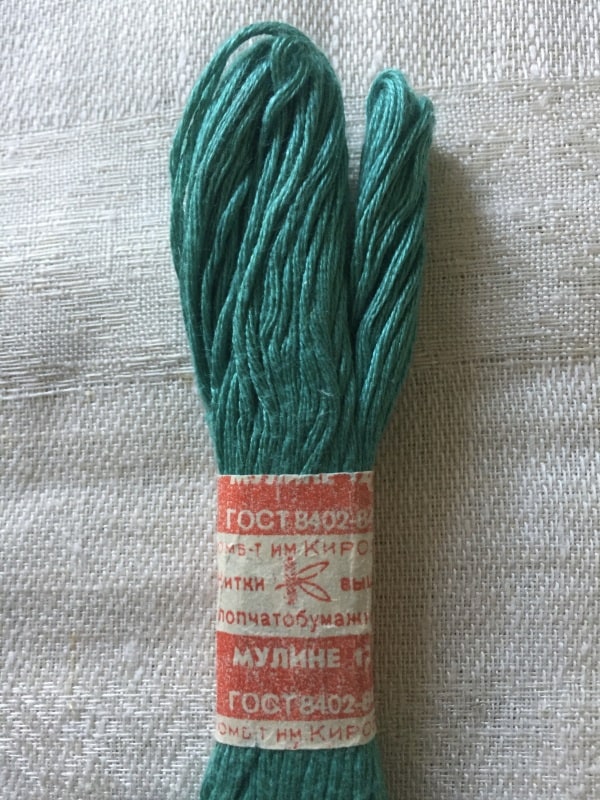
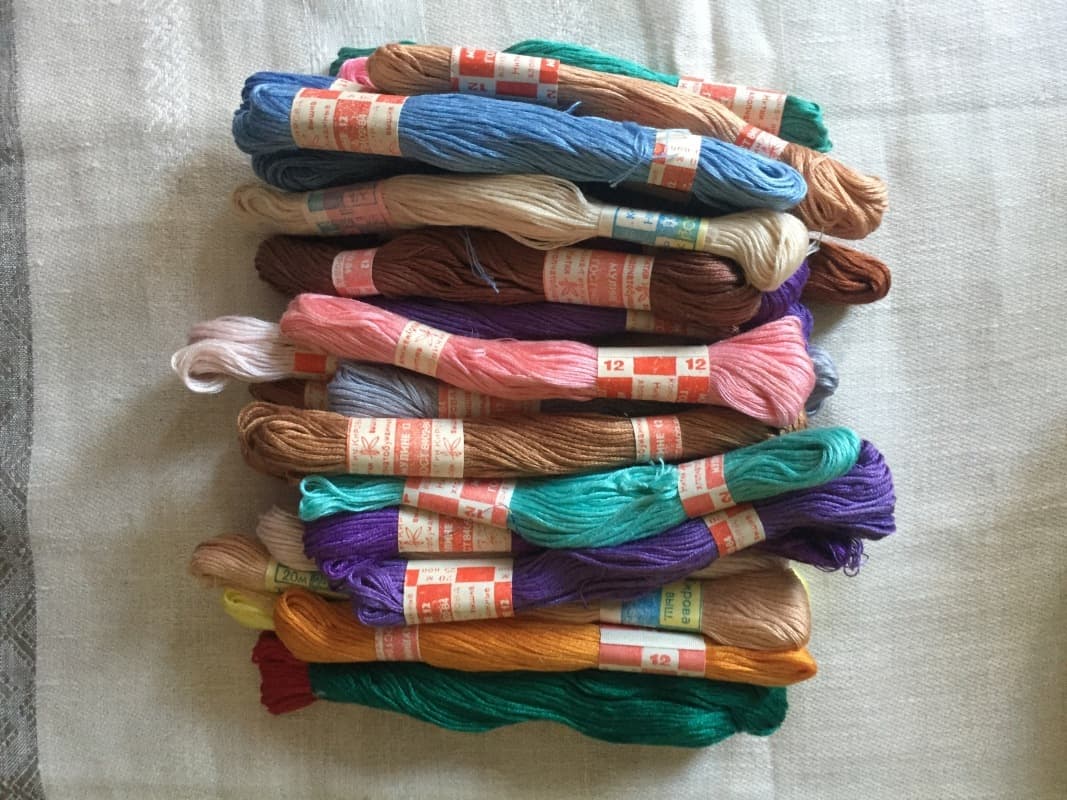
In TsUM I also bought a small panel printed with the design of a firebird, which I assume is meant to be worked over in cross-stitch, some lovely hand-made lace for trimming, sold by the metre, and a round lace mat.


It took me some time to find fabrics that I wanted to buy. There was a large section of dressmaking-weight materials on the ground floor in GUM but they all seemed to be synthetic, such as polyester or rayon, and imported from China or the Far East. I couldn’t find any cotton or linen fabric there, certainly not anything produced in Russia. My observation was that these synthetic fabrics were very popular with the Soviet customer. (I’ll say more about this when I finally write my promised post about Baranov printed cottons…). A shop in the Arbat sold linen tablecloths and pieces of lace and embroidered items but they were aimed at the tourist market and extremely expensive.
In most shops, including food shops, toy shops and department stores such as TsUM and GUM, the system was to choose what you wanted to buy and the assistant on that counter would write out a chit, which you would take to the Kacca (cash desk). Having paid and been given a receipt, you would return to hand it over at the original counter and be given your purchase. I remember there sometimes being an additional stage where someone else had to wrap it. I found this a pleasant nostalgic reminder of shopping in the bookshop Foyles, on Charing Cross Road, London, which preserved that system long after all other shops here had abandoned it. (An extract from Wikipedia on Foyles … ‘The shop operated a payment system that required customers to queue three times: to collect an invoice for a book, to pay the invoice, then to collect the book, because sales staff were not allowed to handle cash. The shelving arrangement categorized books by publisher, rather than by topic or author. A quote of this period is “Imagine Kafka had gone into the book trade”…’) I didn’t enjoy that system so much when I once went to the wrong Kacca in GUM, thinking that any one would do. I hadn’t realised that each counter related to a particular cash desk, and I had to start queuing to pay all over again.
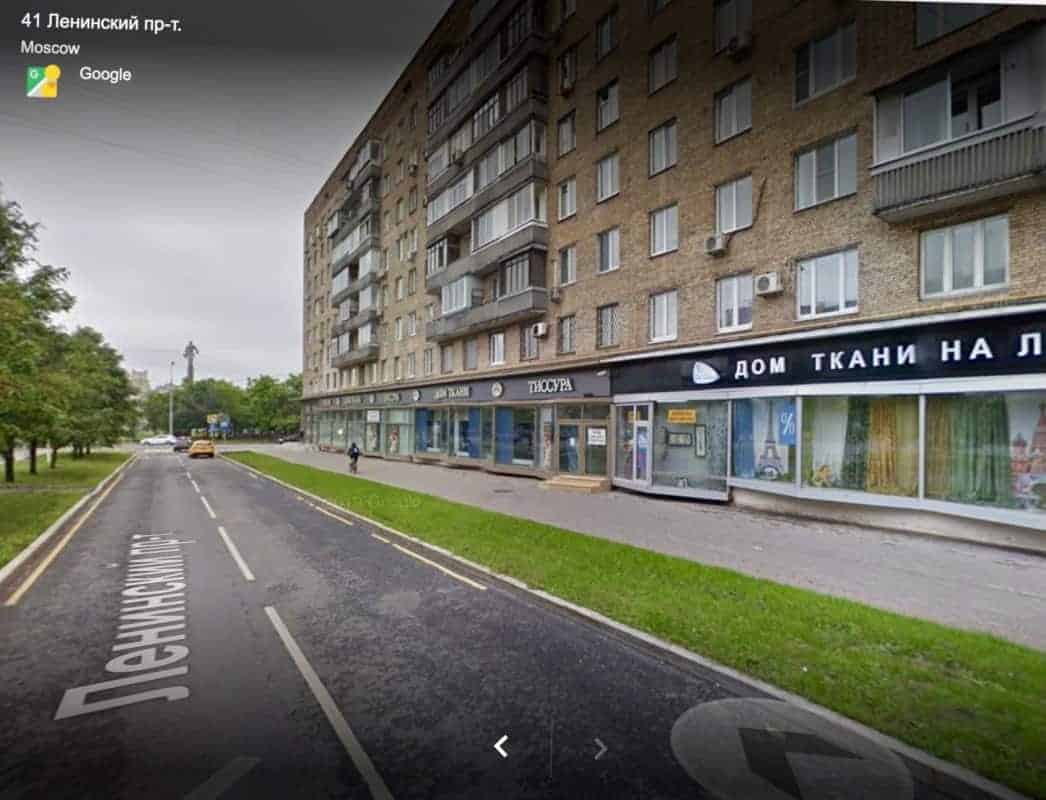
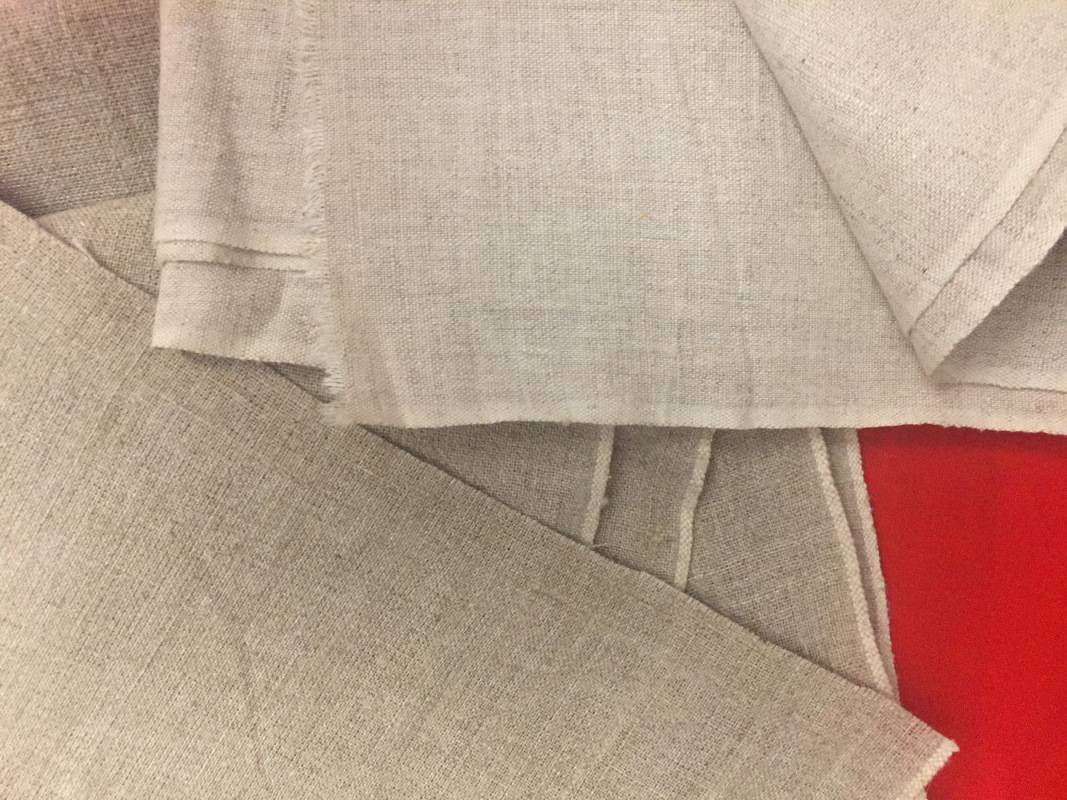
I finally found out about Dom Tkani (Дом Ткани / House of Fabric), a large shop on Leninskiy Prospekt, which I think is still in the same location. This was not at all crowded, unlike the central Moscow stores, and they sold the most gorgeous bleached and unbleached linen of various weights. And really cheap.


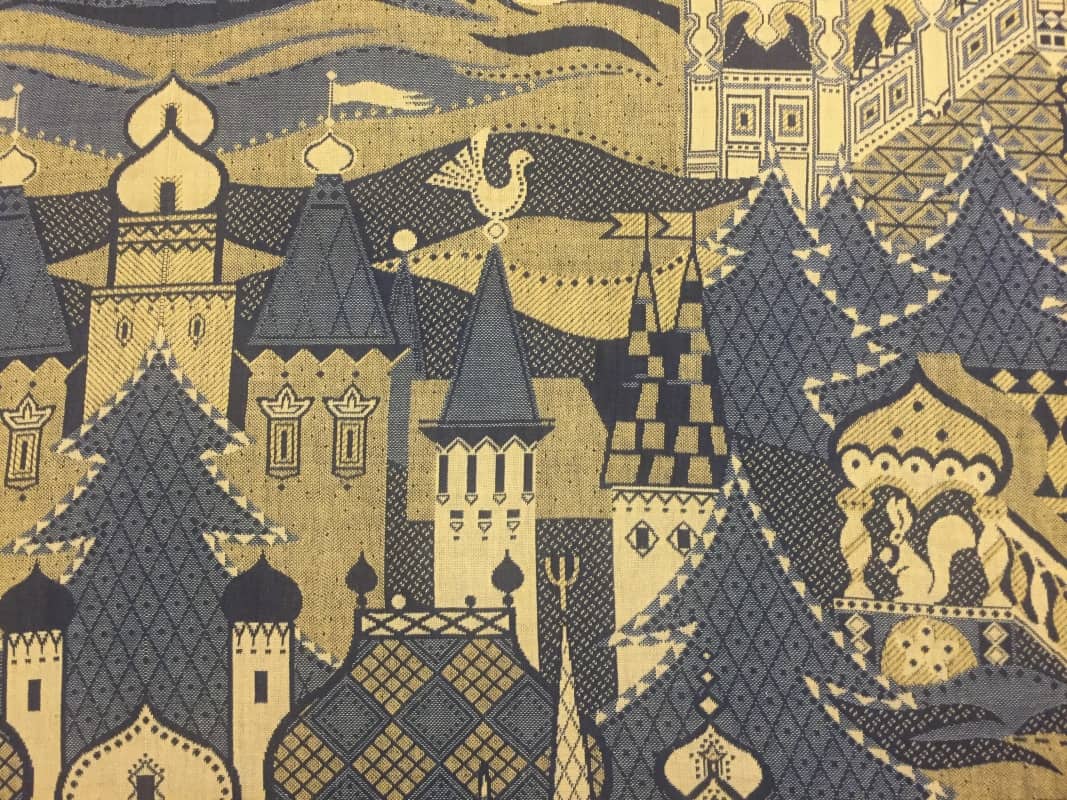
In Dom Tkani I also bought a length of furnishing fabric, which is one of my favourite things from 1987. I always take it with me when I go to speak to groups and use it as a tablecloth on which to lay out some of my Russian textile collection.
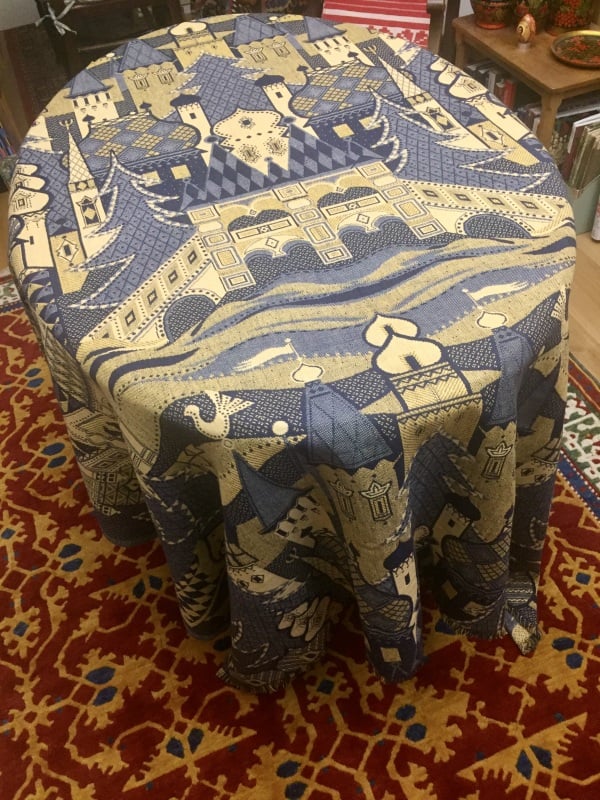
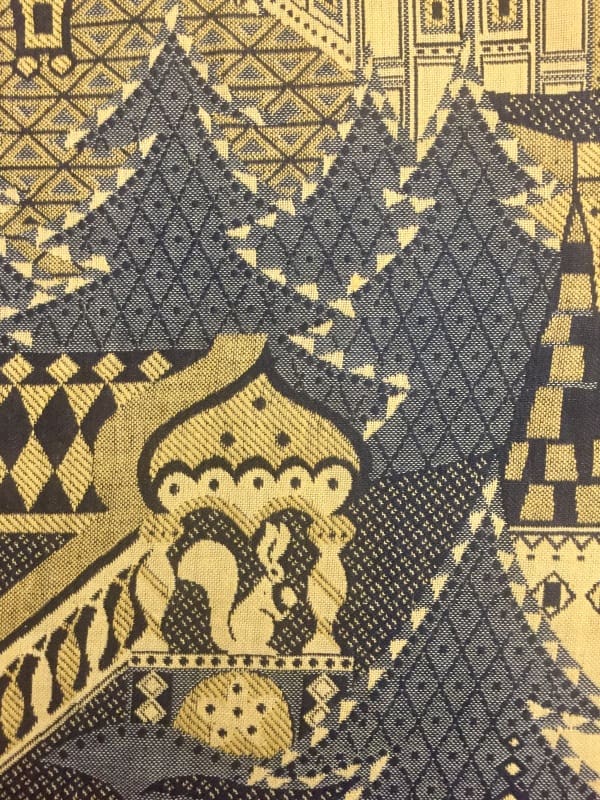
In the end I bought far more fabric and thread than I needed for my college projects. I’ve used more of the linen over the years, but still have plenty. I’m glad I kept everything as it continues to remind me of that happy and fulfilling time.
What an interesting post! The skeins look like sashiko thread, most attractive. Can’t wait to search out Dom Tkani when we can travel again. Looking forward to your article on the Russian printed cotton industry